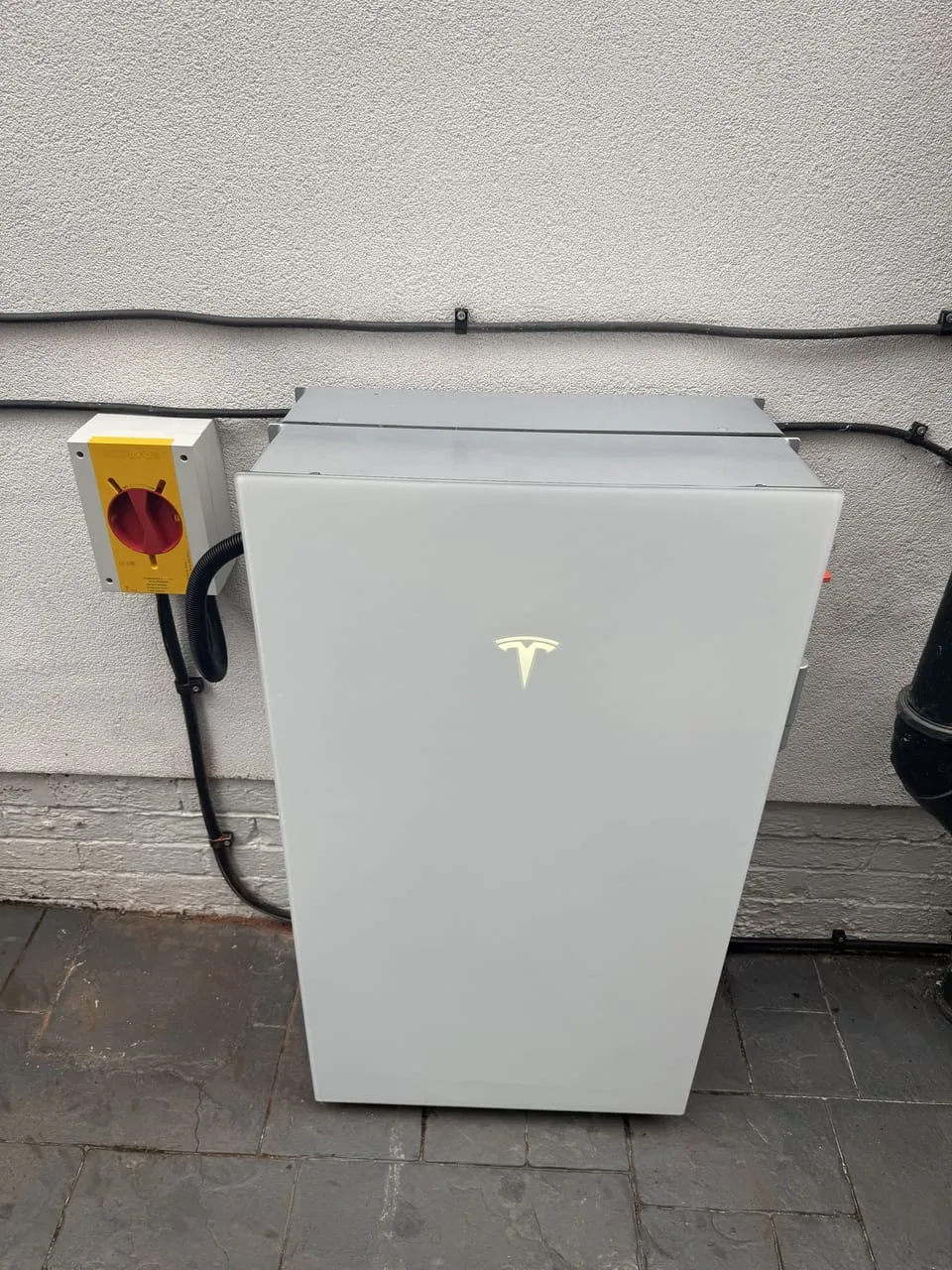
Tesla’s Powerwall 3 has become the battery everyone asks about by name — a rare feat in an industry where most punters can’t name a single inverter brand. It looks brilliant on the wall, it’s backed by a company that (for now, at least) makes batteries for a living, and it promises a simpler install than the multi-box systems it’s up against. But “premium” cuts both ways here: you get genuine engineering advantages, and you get a price tag and a set of limitations that won’t suit every home. This review looks at what the Powerwall 3 actually does well, where the integrated-inverter design becomes a straitjacket rather than a feature, and how it stacks up — literally — against the cheaper modular batteries most UK installers fit day to day.
What the Powerwall 3 actually is
Unlike the original Powerwall and Powerwall 2, which were AC-coupled battery boxes that sat alongside a separate solar inverter, the Powerwall 3 has a built-in 11.5kW hybrid solar inverter. That’s the headline change. Instead of your solar panels feeding a string inverter, which feeds AC into the battery’s own inverter, the Powerwall 3 takes DC straight from the panels, does the DC-to-AC conversion itself, and manages charging and discharging from one box. On paper that’s fewer conversion losses, fewer boxes on the wall, and one company’s software running the whole show.
Usable capacity is 13.5kWh, in line with most premium home batteries, and the built-in inverter is rated for up to 11.5kW of solar input and can output around 5kW continuous (11.5kW peak) — enough for a genuinely hungry home with an induction hob, a heat pump and an EV charger all trying to run at once. Tesla also quotes a 97.5% round-trip efficiency figure for the unit, which sits at the better end of what’s available for AC- or DC-coupled home storage.
Backup capability is good but not whole-house-by-default: you need the separate Backup Gateway and, depending on your consumer unit, some rewiring to get whole-house backup rather than just a few circuits. That’s not unique to Tesla — most battery systems need a transfer switch or gateway of some kind for outage cover — but it’s an extra cost line that catches people out when they’ve budgeted from the headline unit price alone.
The integrated-inverter pros
The case for building the inverter into the battery is genuinely strong, and it’s worth being fair to it before we get to the catches.
Fewer boxes, fewer failure points, tidier install. A conventional solar-plus-battery retrofit often means a string inverter, a battery inverter, and the battery itself — three units, three sets of cabling, three things that can go wrong. The Powerwall 3 collapses that to one box handling solar input, battery charge/discharge and grid export in a single unit. For a new-build install or a full rip-and-replace on an older system, that’s a genuinely tidier job and a shorter working day for the installer.
One firmware stack, one app. Tesla’s app is well regarded and gets pushed updates fairly regularly — export limits, grid-support features and firmware fixes have all rolled out over the air. When solar, storage and grid interaction all live inside one company’s control software, you avoid the classic “which manufacturer do I blame” support loop that plagues mixed-brand systems.
Strong continuous power output. At up to 11.5kW peak / ~5kW continuous, the Powerwall 3 can genuinely run demanding loads — a heat pump compressor cycling on, an induction hob, and an EV charger overlapping — without buckling in the way some older, lower-output batteries do. For homes going all-electric (solar + heat pump + EV), that headroom matters more than the kWh figure on the spec sheet.
Integrated DC solar input up to 20kW of panels. Because the inverter is built in, you can size a solar array well beyond what the battery itself stores, useful for bigger roofs that want to maximise self-generation even if the battery fills up by lunchtime.
The no-stacking catch
Here’s the part that trips a lot of buyers up, and it’s the single biggest thing to understand before you sign anything: UK Powerwall 3 installs (single-unit hybrid inverter models) generally support only one Powerwall 3 per hybrid inverter unit — you can’t simply bolt a second unit onto the same inverter the way you can slot a second or third stackable battery module onto most other systems. If you want more storage, you’re generally buying a second complete Powerwall 3 (inverter and all), not a cheap extra battery module. Tesla does offer expansion units in some markets and configurations are evolving, but for most UK domestic installs the practical reality has been: one Powerwall 3 covers roughly 13.5kWh, and scaling up storage means scaling up cost in big, inverter-sized steps rather than small, battery-sized ones.
Compare that with the stackable systems — GivEnergy, Growatt, Puredrive, Alpha ESS and similar — which are built from the ground up around a single hybrid inverter with battery modules that clip on in ~2.6–5kWh increments. Want 20kWh instead of 10kWh? Add two more modules to the same inverter for a few thousand pounds. Want 20kWh of Powerwall? You’re likely looking at a second full unit, inverter included, because the sizing on the single-unit model doesn’t flex the same way.
This matters most for two groups: homes that expect their electricity needs to grow (an EV or a heat pump on the horizon, a home office, a growing family) and homes on larger properties that already know 13.5kWh won’t cover an overnight cycle. If either of those describes your situation, ask your installer very specifically how the quoted system scales before you commit — don’t assume it works like every other battery on the market, because it doesn’t.
Price versus the stackable competition
Realistic UK installed pricing for a Powerwall 3 (unit plus Backup Gateway plus installation) tends to land around £8,500–£10,500, depending on region, roof complexity and whether whole-house backup is specified. That’s broadly comparable to premium stackable systems at the same usable capacity, but the stackable alternatives usually undercut it once you look at cost-per-kWh at larger sizes, precisely because of the modular scaling above. A typical UK domestic battery more generally — non-Powerwall, various brands and chemistries — runs roughly £400–£700 per kWh installed, so a 13.5kWh system from a mainstream stackable brand can come in meaningfully under Tesla pricing, especially once you’re comparing like-for-like installed capacity rather than brand name.
None of this makes the Powerwall 3 poor value — the integrated inverter, app ecosystem and brand-backed warranty are real things you’re paying for — but “premium box, premium price” is an accurate summary. If your priority is the lowest cost per kWh of storage and you’re happy to manage a two-box system (separate inverter plus stackable battery), a cheaper stackable setup will usually win on pure economics. If you want the tidiest single-box install, strong continuous output, and you’re confident 13.5kWh (or occasionally 27kWh across two full units) covers your needs long-term, the Powerwall 3 is a genuinely well-engineered option.
Where it fits in the wider 2026 picture
It’s worth remembering the policy backdrop while you’re costing any of this. Residential solar and battery storage still qualify for 0% VAT in Great Britain until 31 March 2027, after which the rate is scheduled to return to 5% — so timing a purchase inside that window is worth roughly 5% off the whole install, Powerwall or otherwise. There’s no universal home-solar grant in England (support is means-tested via ECO4 and Warm Homes for low-income, low-EPC households), and the Boiler Upgrade Scheme’s £7,500 only applies to heat pumps, not solar or storage — a distinction that still catches people out. On the export side, Smart Export Guarantee rates vary by supplier rather than being fixed nationally, with the best tariffs currently around 12–20p/kWh, so which supplier you export to matters as much as which battery you buy.
If you’re weighing up whether a battery — Tesla or otherwise — actually pays for itself, thecostofsolar.co.uk’s battery storage cost breakdown is a useful sense-check on installed pricing across brands, and their payback period guide walks through the maths on import-rate savings versus export income. For the general “do panels even work here” and upkeep questions that come up alongside any battery purchase, do solar panels work in the UK’s climate and our maintenance guide are worth a read.
Getting quotes and installer fit
Because the Powerwall 3 is an MCS-certifiable, hybrid-inverter product, it needs an MCS-certified installer for Smart Export Guarantee eligibility regardless of who fits it — that’s not optional, and it’s worth checking a fitter’s certification before anything else. Tesla-approved installers are still relatively thin on the ground compared with the number of installers who can fit a GivEnergy or Growatt stackable system, so lead times and local availability can be a real factor in the decision, not just the spec sheet.
If you’re in South Yorkshire, ElectriFusion Solutions covers both solar and the electrical work a Powerwall install needs around Doncaster; further north, Ecoaim handles solar-plus-battery installs across Central Scotland from their Livingston base. In Lincolnshire, Greenlinc Renewables — sorry, that should read Greenlinc Renewables — are MCS-certified for exactly this kind of hybrid-inverter storage retrofit, and down in South Wales, FLD Electrical in Swansea quote on both solar and battery separately, which is useful if you want an honest Powerwall-versus-stackable comparison from one installer rather than a single-brand pitch. Further south, Solent Solar in Hampshire and Sola UK in the Home Counties both fit premium battery systems and can talk through backup-gateway wiring requirements for full whole-house cover.
Whichever battery you land on, get at least two quotes that separate out the inverter, the battery and the backup gateway as line items — it’s the only way to compare a single-box Powerwall quote against a two-box stackable quote on equal terms, and it stops “premium” simply meaning “harder to price-check.”
Bottom line: the Tesla Powerwall 3 is a well-built, well-supported, genuinely simpler single-box system with strong continuous output — but its inverter-per-battery scaling model means growing your storage later is an expensive step-change, not a cheap add-on module, and cheaper stackable systems will usually beat it on pure cost-per-kWh. Buy it for the integration and the brand, not because it’s the cheapest way to store 13.5kWh.
For the money side — including the Expansion pack and what installation itself costs — see the full breakdown of the Tesla Powerwall 3 cost in the UK.