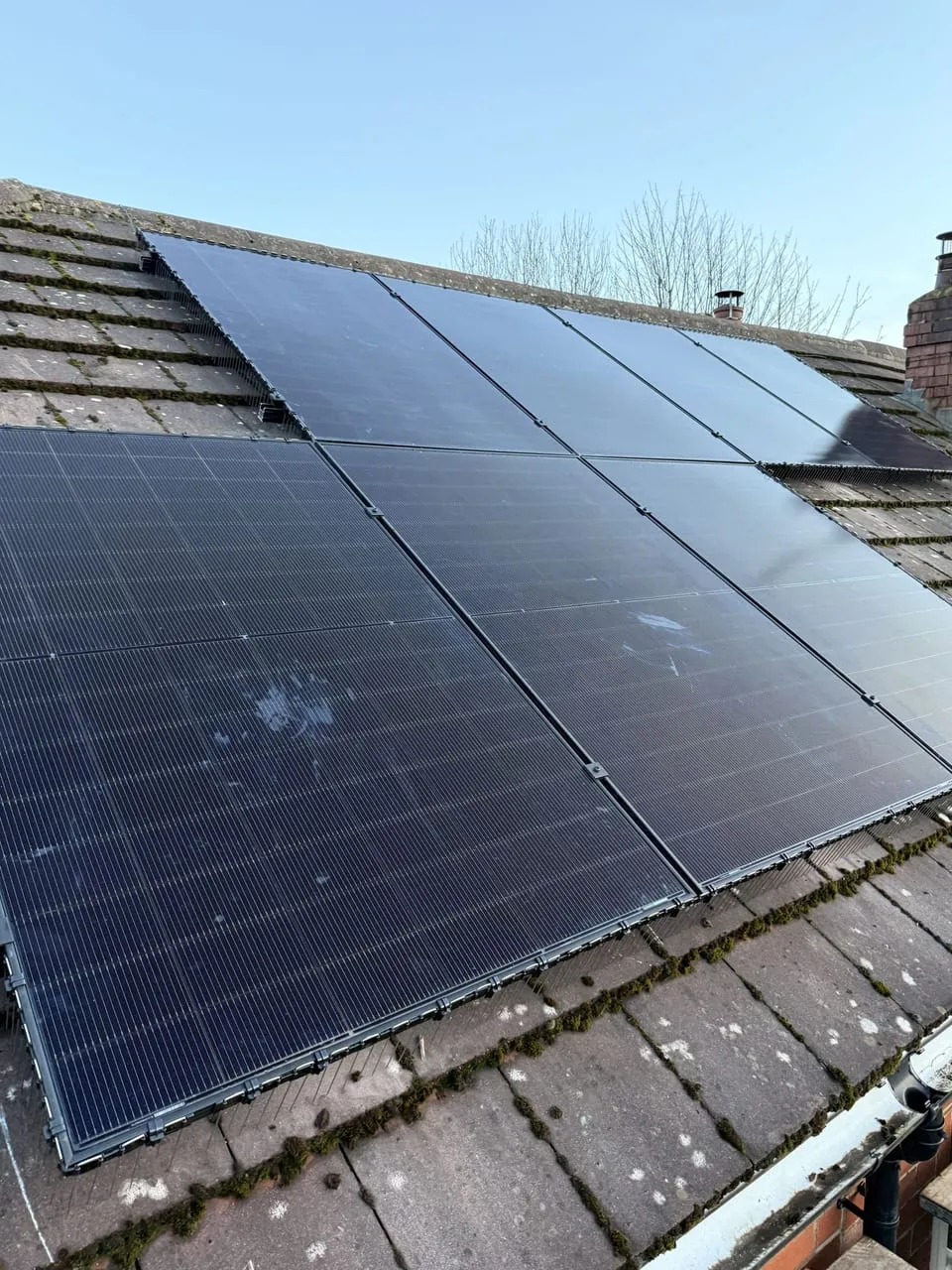
If you’ve ever watched the lights go out next door while your neighbour’s solar-powered house stays lit, you’ve probably wondered why your own panels don’t do the same. It’s one of the most common questions we hear from UK homeowners, and the honest answer surprises most people: for the vast majority of solar installations in this country, a power cut means your panels shut down too — even in bright sunshine. Understanding why, and what it actually takes to get genuine blackout protection, is worth ten minutes of your time before you buy or upgrade a system.
Why a grid-tied solar system switches itself off
Most UK home solar systems are “grid-tied” — the inverter is wired to work in sync with the National Grid, feeding any spare generation back down the same cable that brings power in. That’s efficient and cheap, but it creates a real hazard the moment the street loses power.
If your inverter kept pushing electricity out onto a “dead” line during a cut, it could electrocute a network engineer working to restore supply streets away. To prevent this — a phenomenon engineers call “islanding” — every grid-tied inverter sold in the UK has automatic anti-islanding protection built in. Within a fraction of a second of detecting the grid has dropped, the inverter disconnects itself completely and stops generating, regardless of how sunny it is outside.
This isn’t a fault or a design flaw. It’s a legal requirement under the G98/G99 grid connection standards that MCS-certified installers must follow, and it’s there for the safety of anyone working on the network. It does mean, though, that a “normal” solar-only system gives you precisely zero backup power when you need it most — during a storm-related outage, for instance, which is exactly when people most want their lights and freezer to keep running.
The difference a battery (and the right inverter) makes
Adding a battery to your solar system doesn’t automatically solve this. A grid-tied battery inverter without islanding protection will still shut down with the grid, battery or no battery — it simply has nowhere it’s allowed to send power.
What actually delivers blackout cover is a system with an Emergency Power Supply (EPS) or “backup” mode, sometimes marketed as a full home backup or automatic transfer switch. Here’s how it works in practice:
- The grid drops.
- The inverter’s anti-islanding logic detects the loss within milliseconds and disconnects from the grid to protect network engineers.
- A separate changeover switch — sometimes built into the inverter, sometimes a standalone box — isolates your home’s wiring from the street entirely.
- The inverter then re-energises a specific “backup” circuit (or, on some systems, the whole consumer unit) using stored battery power, and your solar panels can keep charging that battery through the outage.
Crucially, most retrofit battery systems only back up a handful of designated circuits — lighting, sockets, the fridge-freezer, maybe the boiler control — rather than the entire house, because sizing an inverter and battery to run an electric shower or immersion heater through a multi-hour cut would be prohibitively expensive for most households. The switchover itself typically takes anywhere from a few milliseconds (near-seamless, no flicker) to a few seconds depending on the hardware, which is fine for lighting and electronics but can occasionally reset a router or a clock.
It’s also worth being clear about capacity: a typical domestic battery of 5-10kWh will comfortably run backup essentials for several hours to a day depending on load and season, but it is not designed to power a home indefinitely through a multi-day outage the way a diesel generator might. Think “bridge you through the night” rather than “off-grid forever.”
Not every “battery-ready” system actually has backup
This is the bit that catches people out. A huge number of battery installations sold in the UK over the past few years are grid-tied only, with no EPS function at all — often because the cheaper inverter model was chosen, or because backup wasn’t specified at the point of sale. If blackout protection matters to you, you need to ask explicitly:
- Does the inverter have EPS/backup output, and is it enabled (some support it in hardware but it needs commissioning)?
- Is a backup changeover switch or gateway fitted?
- Which circuits are on the backup board, and is that enough for what you need (fridge, lighting, Wi-Fi, medical equipment)?
- What’s the realistic switchover time, and does it matter for your equipment?
- Will the battery keep charging from the panels during a prolonged daytime outage, or only run down?
If you’re speccing a new system, this is a conversation worth having with your installer up front rather than discovering the gap during the next storm. Installers like FLD Electrical in Swansea and Premier Electrical Renewables, who fit both solar and battery storage as standard, can talk you through which inverter and battery combinations actually include genuine EPS functionality versus which are grid-tied only — the spec sheets alone don’t always make it obvious.
What backup is actually worth to you
Before spending extra on EPS-capable hardware, it’s worth being honest about how often UK power cuts actually affect you. If you’re in a well-served urban area with underground cabling, outages might be rare and short. If you’re rural, on overhead lines through wooded areas, or simply remember a bad storm season, the calculus shifts. Common real-world reasons UK households retrofit backup capability:
- Rural properties on overhead lines prone to storm damage
- Home working setups that can’t tolerate a dead broadband router and PC
- Medical equipment (oxygen concentrators, stairlifts, fridge-stored medication) that must stay powered
- Homes with electric gates, sump pumps or borehole pumps that fail without power
- Simply wanting the freezer to survive an overnight cut without a big shop being lost
If none of those apply, a standard grid-tied system with a battery for bill-saving and export optimisation may be all you need — EPS adds cost for a benefit you might rarely use. If several apply, it’s worth pricing properly.
What it costs to add real blackout protection
As a rough guide for 2026: a battery on its own typically runs from around £4,000-£8,000 fitted depending on capacity (roughly £400-£700 per kWh of storage), with something like a Tesla Powerwall 3 (13.5kWh) sitting nearer £8,500-£10,500 installed. Adding genuine EPS/backup functionality — the correct inverter, a changeover switch and rewiring the backup circuits — typically adds several hundred to low-thousands of pounds on top, depending on how much of the house you want covered and whether it’s a retrofit to an existing solar array or part of a new install.
The 0% VAT relief on residential solar panel and battery storage installations in Great Britain, in place until 31 March 2027, applies to genuine EPS-capable systems just as it does to standard grid-tied ones, so there’s no VAT penalty for specifying backup — it’s purely the hardware and labour that costs more. After that date VAT is scheduled to revert to 5%, so anyone weighing up an EPS upgrade has a genuine incentive to get it specified and installed before the deadline rather than after.
If cost is the deciding factor, it’s worth getting a couple of quotes that separately itemise the battery and the backup/EPS hardware, so you can see exactly what the blackout-proofing element costs versus the underlying storage. Regional installers such as Ecoaim in Livingston and Hazell Electrical in West Kent both fit residential battery systems and can price backup-capable configurations against grid-tied-only alternatives so you’re comparing like for like.
Commercial and larger-scale sites face the same issue, at bigger stakes
The anti-islanding rule isn’t unique to homes — it applies equally to commercial rooftop and ground-mount arrays, and the consequences of an unplanned outage are often far more serious for a business: stopped production lines, spoiled cold storage, failed servers. Larger sites more commonly justify a proper UPS-backed or generator-hybrid solution alongside solar rather than relying on a domestic-style EPS retrofit, and the economics work differently because the avoided-downtime cost is so much higher. If you’re assessing this for a warehouse, factory or care facility, Solar Panels for Warehouses and Solar Panels for Care Homes both cover the resilience side of commercial solar specification in more depth, including how battery sizing and backup priorities differ from a domestic system. For businesses weighing whether to fund backup capability alongside a wider solar-plus-storage investment, Battery Storage for Business is a useful next stop on how commercial-scale systems are typically financed and sized.
The bottom line
A standard grid-tied solar system, with or without a battery, will switch itself off in a power cut — that’s a safety feature, not a fault, and it’s true across the whole UK market unless the system has been specifically built with EPS/backup capability. If blackout protection matters to you, the fix isn’t “get solar” or even “get a battery,” it’s “get the right inverter, changeover switch and circuit wiring for backup,” and that needs to be specified explicitly rather than assumed. For a wider look at how battery costs break down before you get quotes, our sister site’s guide to solar battery storage costs is a good companion read, and if you’re still weighing up whether solar is worth it for your home at all, our own piece on whether solar panels are worthwhile in the UK climate covers the fundamentals. Whatever you decide, ask any installer quoting you directly whether EPS is included, enabled and correctly wired — don’t assume “battery” means “backup.”